Many congregation members sacrificed and donated time and money to make the new sanctuary building a beautiful place to worship. Among them was Madge Whitman, whose donation made the stained glass windows possible. These beautiful windows were designed by Roch E. Babin of Kansas City, Missouri, and were built by City Glass Company from Fort Wayne, Indiana.
Trinity Windows
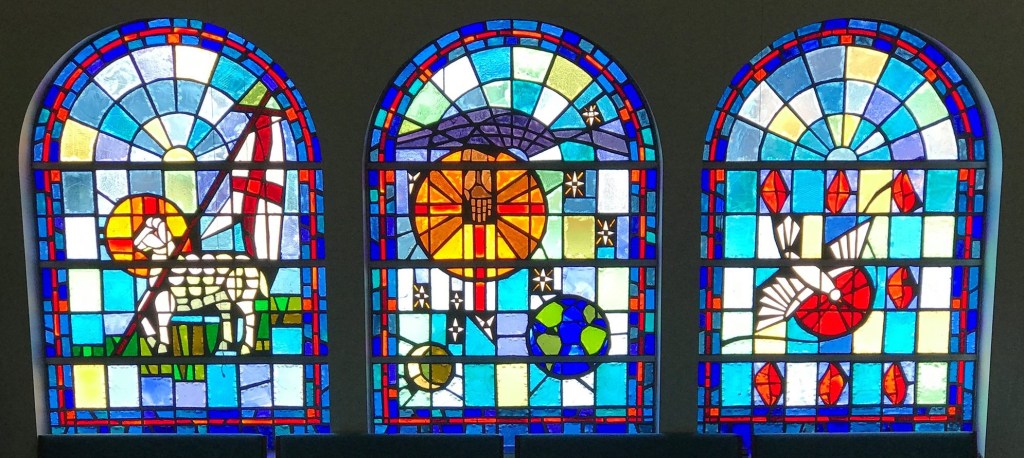
The Trinity Windows are located behind the sanctuary, where the pulpit sits. In the center window, God the Father is symbolically illustrated. The main symbol for the father is a right hand extending downward in blessing. This is an ancient symbol, dating back to the beginnings of the Church. It was the only symbol of the Father for the first nine hundred years of church history. Surrounding the hand is the tri-radiant nimbus. This is a special type of halo from which three rays of light emerge. It is used exclusively to designate a member of the Trinity. This design depicts the Father as Creator of the universe. The earth, the moon, and stars represent the physical universe.
On the right hand of the window representing the Father (left if viewed from the interior) is the window representing the Son. The most authentic and beautiful symbol of Our Lord is the lamb. “Behold the Lamb of God, which taketh away the sins of the world” (John 1:29). The lamb was a sacrificial animal in ancient times and so represents the sacrificial aspects of the story of Christ. The tri-radiant nimbus indicates a member of the Trinity. The lamb carries the Banner of Victory. This is a white banner with a red cross. It symbolizes the victory of Christ over sin and death.
The descending white dove is the symbol for the Holy Spirit. All four evangelists record the appearance of the Holy Spirit in such a form at the Baptism of Christ. The tri-radiant nimbus is used again. Seven flames surround the dove; they represent the seven gifts of the Holy Spirit: wisdom, knowledge, counsel, fortitude, understanding, piety, and fear of the Lord. This particular combination of symbols is used to represent Pentecost.
The Lord’s Supper
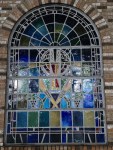
Two windows flank the entrance of the church; one of which is the Lord’s Supper. The final meal of Christ with His Apostles is represented by a broken loaf of bread and a chalice. These symbolize the body and blood of Christ. Wheat and grapes are also used for this particular theme and is included in the design as secondary symbols.
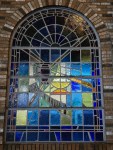
Service
On the other side of the entryway, the window includes the symbols for service to others. These are a pitcher, basin, and towel. These symbols refer to the washing of the Apostles feet by Christ.
The Eternal Word
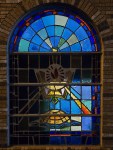
From left to right along Elm Street, we have the life of Christ on either side of the Trinity in four window designs. The first window is based on the concept of the Eternal Word of God. Symbols for this missionary window are the open book and the lighted lamp. The open book represents Scripture, the Word of God which is the eternal Christ, who is accessible to all the people of the world. The lighted lamp is a symbol of Knowledge.
The Nativity
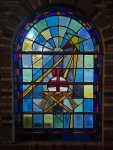
The birth of Christ is illustrated by the manger, the chi rho and the five-pointed star. The chi rho is the monogram of Christ. It is formed by the combination of the first two letters of the Greek spelling of the name of Christ. The five pointed star is known as the Star of Bethlehem which led the Wise Men to the Messiah.
The Crucifixion

Three crosses against the sky represent the death of our Savior. The crown of thorns is used to represent the suffering Christ endured for our sins.
The Resurrection
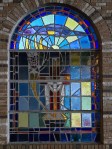
The essential mystery of Christian belief is illustrated symbolically in the final window of the series. Symbols of the resurrection of Christ include the empty cross and the butterfly. The butterfly is an ancient and quite appropriate symbol. Like a butterfly, the Christian dies, is entombed, and is reborn into a new and more glorious form.
The Transformation of Water into Wine
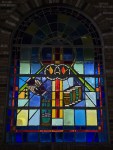
This window is located between the buildings and depicts the miracle performed at the Wedding Feast at Cana, which marks the beginning of the public life of Christ. Appropriate symbols are a water jar being poured into another, interlocking rings signifying marriage, and a cross symbolizing the presence of Christ.
 Logan Church of the Nazarene